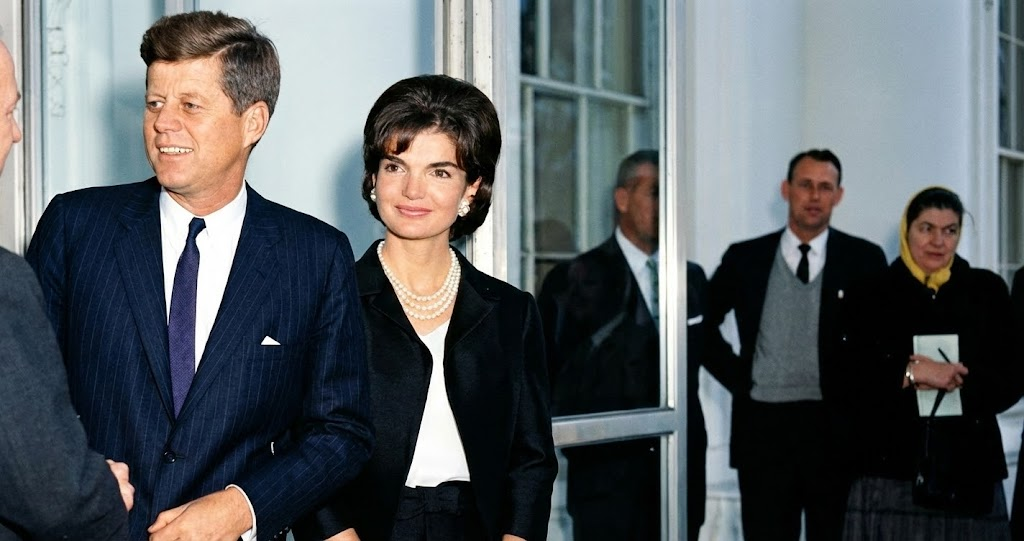
In December 1963, Jacqueline Kennedy walked out of the White House believing she would never return. Just two weeks earlier, her world had shattered in Dallas. Her husband was gone. Her children—Caroline, not yet six, and John Jr., not even three—had lost their father before they could understand what that meant. Every corridor of that house carried echoes she could not survive again. So she left, certain it was forever.
In the years that followed, Jackie rebuilt a life far from Washington. New York became her refuge. She protected her children fiercely, shielding them from cameras and memories that refused to fade. She avoided the White House entirely, even though it held a chapter of her life that history would never forget.
Then came a request she never expected to face.
Official portraits of President John F. Kennedy and Jacqueline Kennedy were to be unveiled at the White House. Tradition demanded her presence. The East Room. The cameras. The world watching her stand where she had once stood beside him. Jackie knew she could not endure that moment in public.
Instead, she wrote a letter—handwritten, personal—to First Lady Pat Nixon. She asked for something unheard of: to visit quietly, privately, without press or ceremony, just her and her children. The request crossed political lines that had once been bitter and personal. But Pat Nixon did not hesitate. She said yes.
What followed was an act of grace few people knew about for years.
On February 3, 1971, a military jet was sent to New York. After school, Caroline and John Jr. boarded a plane at the airport named for their father. Only six people knew of the visit. No reporters. No photographs. No announcement.
That evening, the Nixon family welcomed the Kennedys into the White House. They walked first to the portraits. John Kennedy’s painting showed him looking downward, thoughtful, heavy with the weight of leadership. Jackie had approved it because it felt honest. Standing there, with her children beside her, she finally faced him again.
Pat Nixon stepped away, allowing the family privacy. No speeches. No audience. Just silence, memory, and love.
They toured the rooms together. Jackie saw the garden named in her honor for the first time. Caroline and John walked through spaces they barely remembered, places that had once been home. Upstairs, the children revisited a life interrupted too soon.
That evening, the families shared dinner privately. Two political rivals, united not by power, but by humanity. Later, President Nixon personally led the Kennedy children into the Oval Office—the room where their father had worked, decided, carried the weight of a nation.
Then, just as quietly, they left.
The visit lasted only a few hours. No photographs were taken. No one spoke of it. The next day, Jackie wrote to Pat Nixon, thanking her for turning a day she had always feared into one of the most precious moments she would ever share with her children.
Sometimes history’s most meaningful moments happen far from cameras—when kindness steps in where politics once stood.