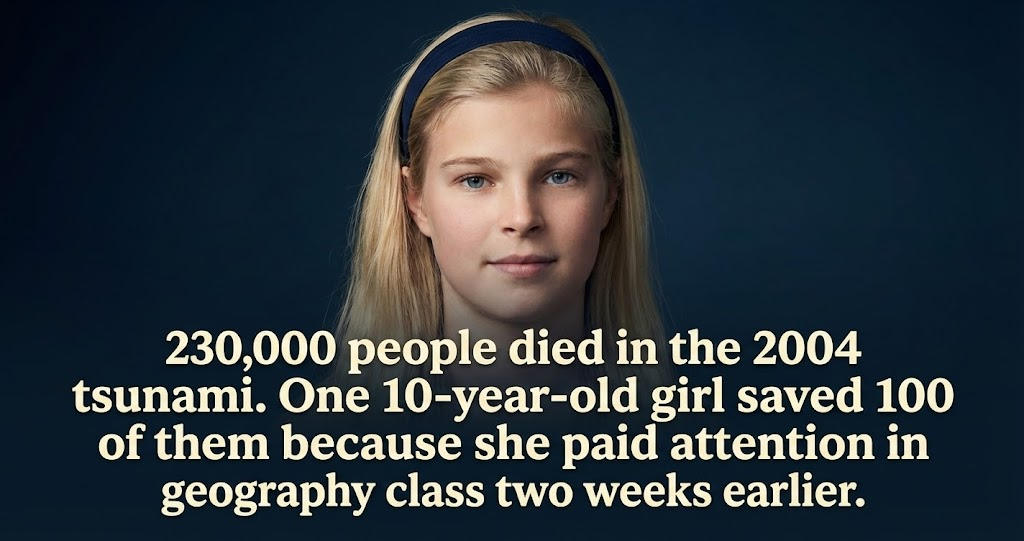
Her name was Tilly Smith, and on the morning of December 26, 2004, she was just a child on her first overseas holiday. Christmas had passed, the sun was bright, and Mai Khao Beach looked like paradise. Tilly walked beside her parents, barefoot in the sand, surrounded by tourists enjoying a quiet morning. Nothing looked dangerous. No alarms. No warnings. But while adults admired the calm horizon, Tilly noticed something deeply unsettling. The ocean wasn’t breathing the way it should. It wasn’t pulling back and returning. It was advancing—slowly, strangely, relentlessly.
At ten years old, Tilly didn’t have experience or authority. What she had was memory. Just two weeks earlier, sitting in a classroom at Danes Hill School in England, she had watched grainy footage of a tsunami from 1946. Her geography teacher, Andrew Kearney, had explained the warning signs: frothy water, strange bubbling, the sea behaving unnaturally. Standing on the beach in Thailand, Tilly recognized every sign. The water fizzed like foam on beer. The tide didn’t retreat. Her stomach dropped. She wasn’t watching history anymore. She was standing inside it.
Tilly began shouting at her parents. She told them a tsunami was coming. There was no giant wave in sight, no reason—on the surface—to panic. Adults around her were relaxed, confused by her urgency. But Tilly refused to quiet down. Fear sharpened her voice. She insisted. She repeated herself. She told them they had to leave now. Her certainty was unnerving, not childish. Her father, Colin Smith, heard something in her tone that made him pause. This wasn’t imagination. This was knowledge.
As fate would have it, an English-speaking Japanese man nearby overheard Tilly say the word “tsunami.” He had just heard news of a massive earthquake near Sumatra. He confirmed her fear. That single moment changed everything. Colin ran to alert hotel staff. Confusion turned into motion. Beachgoers were urged to evacuate. People hesitated, questioned, looked back toward the water. But the warnings spread quickly enough. Tilly’s mother, Penny Smith, was among the last to leave, running as the ocean surged behind her.
They reached the second floor of the hotel with only seconds to spare. Then the wave came. A wall of water nearly 30 feet high slammed into the beach, tearing palm trees from the ground, hurling lounge chairs and debris like weapons. The swimming pool filled with wreckage. The place where families had been walking moments earlier disappeared under chaos. Survival wasn’t just about swimming—it was about not being crushed. Had they stayed, none of them would have made it out alive. Penny later said even standing would have been impossible. The force alone would have killed them.
The Indian Ocean tsunami took more than 230,000 lives across 14 countries. Entire communities vanished. In Phuket, thousands died. But at Mai Khao Beach, something almost unheard of happened. Not a single person was killed. An entire beach survived because one child remembered a lesson most students forget after an exam. Tilly was later called the “Angel of the Beach.” She received international recognition, met world leaders, and spoke at global forums—not because she sought attention, but because the world needed to understand what saved those lives.
Today, Tilly is grown. She lives quietly in London, working in yacht chartering, carrying a past most people can’t imagine. She still credits her teacher. She still believes education is power, not theory. Her father has said without her insistence, they would have kept walking—and died. Two weeks. One classroom lesson. One brave child willing to speak when adults doubted. Tilly Smith didn’t just save her family. She proved that knowledge, when truly learned, can rise louder than fear and faster than any wave.