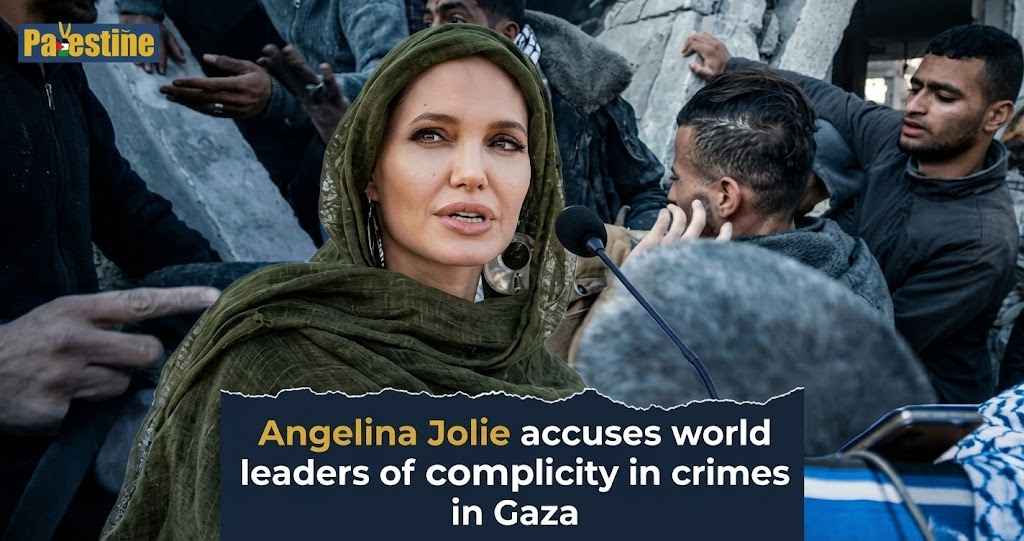
When Angelina Jolie stepped forward to speak about Gaza, it was not with the tone of a celebrity chasing headlines, but with the gravity of someone long familiar with human suffering. Her words cut through noise and politics, focusing instead on civilians trapped between rubble and fear. She accused global leaders of complicity through silence, insisting that neutrality in the face of mass suffering is not neutrality at all. For many watching, her statement felt uncomfortable, direct, and impossible to ignore in a world already overwhelmed by crisis.
Jolie has spent decades visiting refugee camps and conflict zones, and that history shaped the way she framed her message. She did not speak in slogans or numbers alone, but in human terms—families displaced overnight, children growing up under constant threat, hospitals struggling to function. Her accusation was not aimed at a single nation, but at a global system that reacts too slowly when civilian lives are reduced to statistics. The message was simple: suffering does not need justification to deserve urgency and protection.
Behind her words was the reality of Gaza, a place where ordinary life has been fractured repeatedly by conflict. Jolie emphasized that civilians cannot be treated as acceptable collateral damage, regardless of political arguments or military objectives. She questioned how international law can exist meaningfully if it is applied selectively. For many listeners, this was the most striking part of her statement—less about blame, more about responsibility, and the moral cost of looking away when warnings have already been issued.
Reactions came quickly and sharply. Supporters praised her for using her platform to amplify voices that rarely reach global power centers. Critics accused her of oversimplifying a deeply complex conflict. Yet even among disagreement, her words forced conversation. That, perhaps, was the point. Jolie did not present herself as an expert on military strategy, but as a witness to humanitarian collapse. She asked not for applause, but for accountability, something far harder to offer in divided political climates.
What made her statement resonate was its timing. The world is saturated with images, updates, and outrage cycles that fade within days. Jolie’s intervention challenged that pattern, reminding audiences that crises do not end when attention shifts. She spoke of fatigue—the kind that allows suffering to continue unchallenged because people feel powerless or numb. Her accusation of complicity was, in that sense, also a challenge to the public, not only to governments and institutions.
There was also restraint in her delivery. She did not shout. She did not dramatize herself. Instead, she spoke steadily, almost quietly, letting the weight of her words do the work. That calmness made the message harder to dismiss. It suggested deliberation rather than impulse, conviction rather than performance. For a moment, the focus shifted away from celebrity culture and back to the people living under the consequences of decisions made far from their homes.
Whether one agrees with her framing or not, the impact is undeniable. Jolie reminded the world that moral clarity rarely comes wrapped in comfort. Speaking out can fracture alliances, invite backlash, and complicate narratives—but silence, she argued, has consequences too. In conflicts where civilians pay the highest price, choosing not to speak becomes a choice in itself. Her words linger not because they solve anything, but because they refuse to let the question disappear.