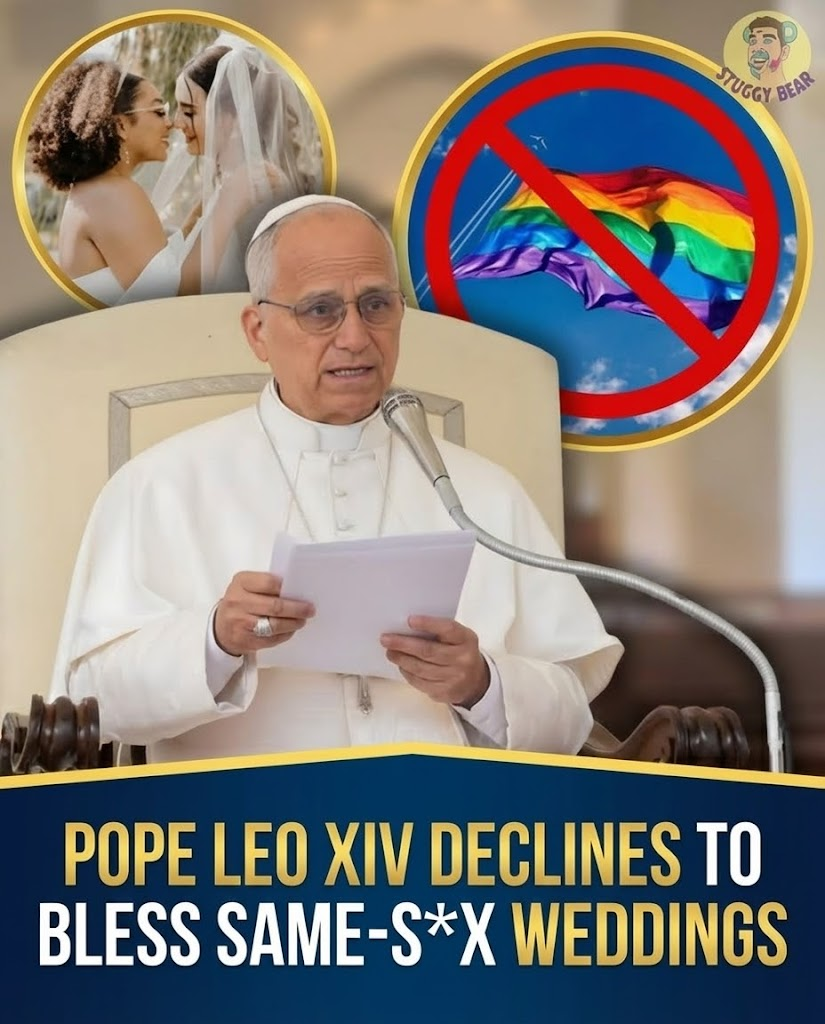
When Pope Leo XIV spoke this week, many expected caution. Few expected clarity delivered with such emotional balance. In a world where every word from the Vatican echoes far beyond church walls, his statement on same-sex weddings immediately captured global attention and sparked intense discussion.
The Pope was firm on doctrine. He stated clearly that the Church will not bless same-sex weddings, reaffirming the long-held belief of the Catholic Church that marriage is a sacred union between a man and a woman. For traditional believers, it was a familiar position. For critics, it was a reminder of where the Church draws its lines.
But the moment did not end there. Instead of closing the door, Pope Leo XIV opened a window. He spoke warmly about human connection, saying he is willing to bless two people who genuinely care for one another. It was not a blessing of marriage, he emphasized, but a blessing of people — of hearts, intentions, and shared humanity.
That distinction mattered. To some, it felt like a softening of tone without compromising belief. To others, it was a deeply personal gesture that acknowledged love without redefining doctrine. The Pope’s words carried an unusual mix of firmness and tenderness, a reminder that faith can hold boundaries while still making room for compassion.
Then came the line that surprised many the most. He asked those listening to pray for him. In that simple request, the authority of the papacy briefly stepped aside, revealing a man aware of the weight he carries and the divisions his words might deepen or heal.
Reactions poured in from all sides. Supporters praised his clarity and consistency. Critics said compassion without change is not enough. Yet even among disagreement, many acknowledged something rare in modern discourse — a leader speaking without hostility, choosing empathy over condemnation.
In the end, Pope Leo XIV did not change Church law, but he shifted the emotional temperature of the conversation. His message reminded the world that belief and kindness do not have to be enemies — and that sometimes, the most powerful statements are the ones that leave room for prayer, reflection, and humanity.