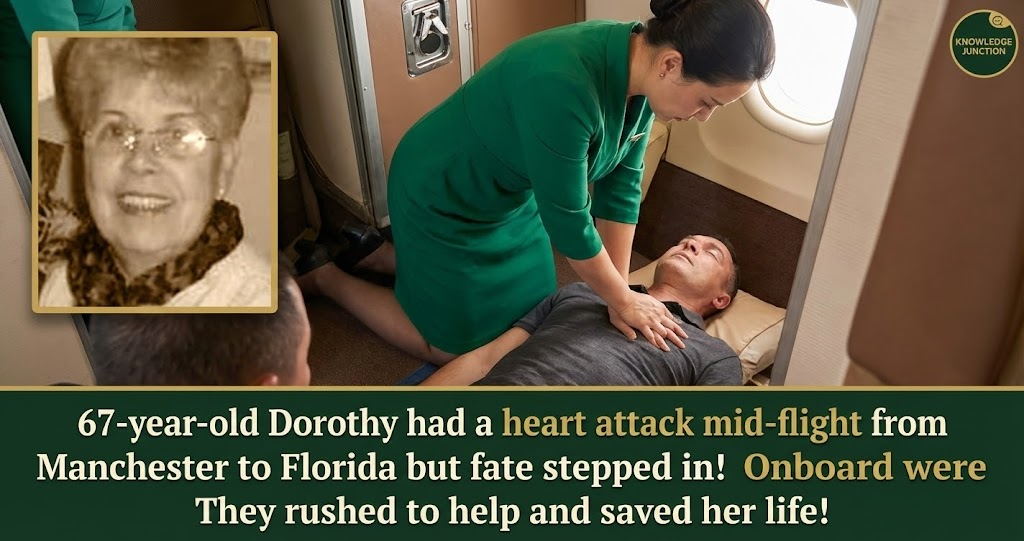
At 30,000 feet above the Atlantic, a routine flight quietly carried its passengers toward Florida. Some slept. Some watched movies. Some counted the minutes until landing. Among them was 67-year-old Dorothy, unaware that this ordinary journey would soon turn into the most frightening fight of her life. There was no warning announcement, no turbulence, no sign that anything was wrong—until her body suddenly betrayed her in the narrow aisle of the plane.
Dorothy collapsed mid-flight. Her heart was under attack. Panic rippled through the cabin as flight attendants rushed to her side, voices overlapping, call buttons flashing. In an airplane, there is no emergency room, no sirens, no quick landing. There is only time slipping away. Every second matters. Every breath counts. Passengers watched in helpless silence, fearing the worst, knowing how unforgiving the sky can be when the human body fails.
Then something extraordinary happened. Not luck—something rarer. Courage, knowledge, and timing aligned in a way that almost feels unreal. Among the passengers were not one, not two, but fifteen cardiologists. Fifteen heart specialists, all traveling to the same medical conference. In a space where coincidence rarely means survival, it suddenly meant everything. Without hesitation, they stepped forward, forming a circle around Dorothy.
The aisle became an emergency ward. One doctor checked her pulse. Another monitored her breathing. Others coordinated chest compressions, airway support, and life-saving decisions with calm precision. Flight attendants assisted as best they could, following instructions, clearing space, handing over supplies. Passengers held their breath as the doctors worked relentlessly, sweat forming, arms aching, minds focused on one goal—keep her alive.
Minutes felt endless. The plane kept flying. Dorothy’s life balanced on expert hands and unwavering resolve. These doctors were not scheduled to work that day. They weren’t in a hospital. They had no advanced equipment, no monitors, no operating room. All they had was training, teamwork, and the refusal to let a stranger die simply because help was miles above the ground.
Slowly, signs of life returned. A pulse stabilized. Breathing improved. The impossible was happening right there between the seats. Relief washed through the cabin, some passengers crying quietly, others whispering prayers of gratitude. The flight crew coordinated with ground medical teams, ensuring immediate care upon landing. Dorothy was alive when the wheels touched the runway—a sentence that had nearly not existed.
Later, the story would spread, leaving people shaking their heads in disbelief. What are the odds? A heart attack mid-flight. Fifteen cardiologists onboard. No hospital. No delay in action. No hesitation. Just human beings stepping into their purpose at the exact moment they were needed. It wasn’t just medical skill that saved Dorothy—it was presence, compassion, and courage under pressure.
Dorothy survived because strangers chose to act. Because years of study met one sudden crisis. Because fate, for once, decided not to look away. This wasn’t just a medical miracle. It was a reminder that sometimes, in the most confined spaces and desperate moments, humanity rises quietly and does its best work—without applause, without planning, just when it matters most.