
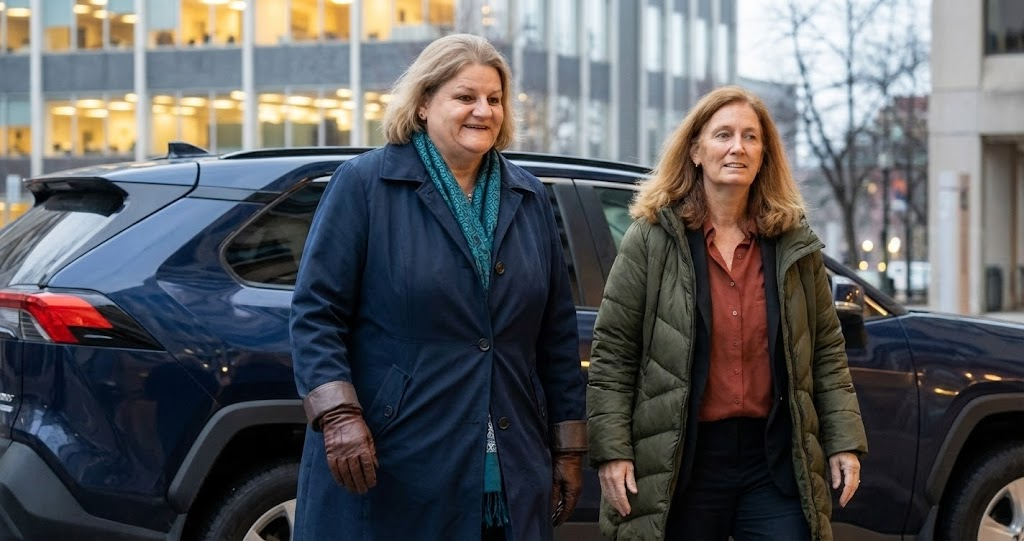
On a quiet courthouse day in Milwaukee, a moment unfolded that would end a judicial career and ignite national debate. Behind closed doors, a sitting judge made a choice she believed she could carry. She knew the risk. She even named it herself. “I’ll do it. I’ll get the heat.” What followed wasn’t a misunderstanding or a technical error. It was a deliberate decision that would lead to a felony conviction and the loss of her judgeship.
That judge was Hannah Dugan, a 66-year-old Milwaukee County judge with decades on the bench. Federal prosecutors later argued that frustration, anger, and personal conviction pushed her past the boundaries of the law she was sworn to uphold. In April, federal agents from the FBI and ICE arrived at her courthouse with a clear purpose: to arrest Eduardo Flores Ruiz, a man previously deported in 2013 who had returned illegally and was facing battery charges.
According to court findings, Judge Dugan did not confront the agents directly. Instead, she sent them down the hall to another office under the pretense of assistance. While the agents were away, she postponed Flores Ruiz’s scheduled court hearing. Then, rather than allowing the legal process to unfold, she personally escorted him out of a back door, intentionally helping him evade arrest inside the courthouse walls.
Prosecutors later presented a recording that proved critical. In it, Dugan could be heard explaining the plan to her court reporter. When her clerk asked whether she should guide the immigrant toward the exit, the judge responded with the now-infamous words: “I’ll do it. I’ll get the heat.” Those words, played back in a courtroom months later, removed any doubt about intent. This was not confusion. It was a conscious act.
Federal agents pursued Flores Ruiz on foot and arrested him outside the building. He was eventually deported in November. But the focus had already shifted. The spotlight turned to the judge herself. This week, a jury convicted Dugan of obstructing an official proceeding, a felony that carries a potential prison sentence of up to five years. She was acquitted on a separate misdemeanor charge, but the damage was already done.
Under Wisconsin’s constitution, a convicted felon cannot hold public office. With the verdict, Dugan’s judicial career effectively ended. Prosecutor Kelly Brown Watzka described her as “a frustrated and angry judge who decided to corruptly take matters into her own hands.” The courtroom, a place meant to embody neutrality and rule of law, became the stage for a cautionary tale about power, boundaries, and accountability.
The case sent a clear message far beyond Milwaukee. Judges are not exempt from the laws they enforce. Personal beliefs, political pressure, or moral certainty do not grant permission to undermine legal process. In the end, the system she attempted to bypass delivered its own verdict. The heat she said she would take arrived—public, permanent, and unmistakable.