On 26 September 1917, amid the mud, smoke, and relentless gunfire of the Battle of Polygon Wood, Private Jack Hunter of Australia’s 49th Battalion was mortally wounded. The battlefield offered no mercy, only chaos and loss. As shells fell and orders blurred into noise, Jack’s younger brother Jim Hunter found him. In the middle of no-man’s land, Jim cradled Jack as life slipped away. There were no last comforts except a brother’s arms, no promises except the silent vow that Jack would not be forgotten.
When the guns finally quieted, Jim did what love demanded. He wrapped Jack’s body carefully in a groundsheet, shielding him from the mud as best he could, and buried him with care where he fell. It was not a grave marked with stone or ceremony, but it was made with devotion. Then the war moved on, as wars always do, leaving behind broken land and broken hearts. Jim survived. Jack did not. And with that, a promise was born—one Jim would carry for the rest of his life.
After the war, Jim returned to Belgium again and again. He walked the scarred fields of Polygon Wood, searching for a place that no longer looked the way it once had. Trenches were gone. Landmarks erased. Seasons passed where death once stood still. Each visit ended the same way—with no grave found. Jim returned to Australia carrying an unfulfilled promise, a grief that never quite loosened its grip. Jack was gone, but not properly laid to rest. For Jim, the war had never truly ended.
Nearly ninety years later, history stirred beneath the soil. In 2006, road crews working near Polygon Wood unearthed the remains of five soldiers. One of them was still carefully wrapped in a groundsheet. Through painstaking work and DNA testing, the truth emerged: it was Jack. Lost for almost a century, he had been waiting—exactly where his brother left him. In 2007, Jack was finally laid to rest at Buttes New British Cemetery, beneath a headstone that reads with quiet power: “At rest after being lost for 90 years.”
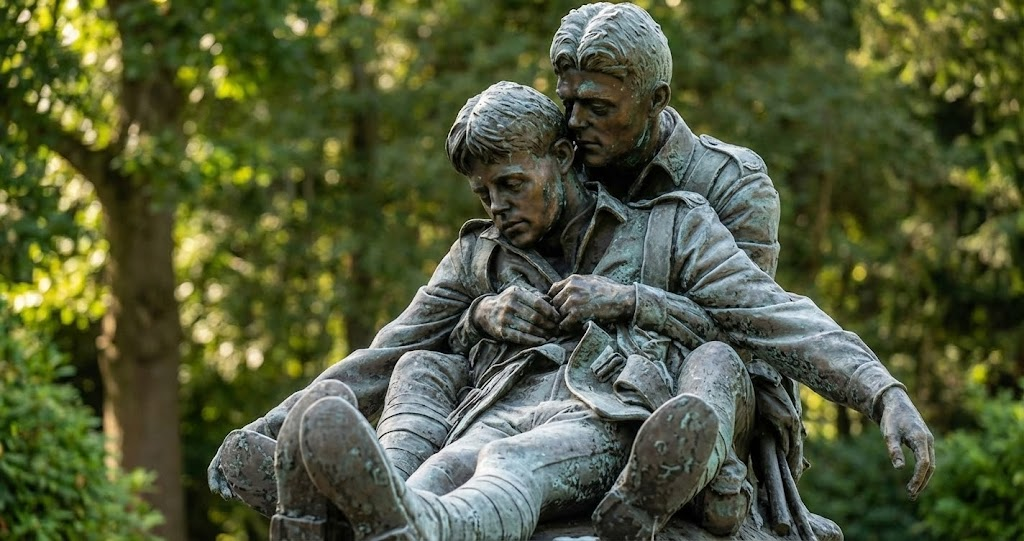
But the story did not end with a grave. Deeply moved by the devotion between the brothers, Belgian archaeologist Johan Vandewalle and supporters founded the Brothers-in-Arms Memorial Project. Together, they raised funds for a bronze statue capturing the most human moment of war—Jim holding Jack, just as he did in Jack’s final moments. It was not a monument to victory, but to love.On 25 September 2022, near Zonnebeke, the 800-kilogram memorial was unveiled, 105 years after Jack’s death. Today, the statue, museum, and surrounding path stand not only for two Australian brothers, but for every sibling torn apart by war. It reminds us that memory is stronger than time, that promises can survive generations, and that love—true love—endures even across a century of silence.