When Carmen calmly announced that she was getting married at eighty-nine, the room filled with laughter that didn’t quite hide the discomfort. Some thought it was a joke. Others feared something worse. Her eldest daughter stared at her, torn between worry and disbelief. Thirty years had passed since Carmen became a widow, thirty quiet years of routine and resilience. Yet there she was, speaking softly about dresses and flowers, about music and a simple ceremony. Her voice carried no confusion—only certainty. And that certainty unsettled everyone, because it forced them to notice something they had ignored for years: Carmen was still here, still feeling, still waiting to be seen.
Carmen lived alone in an aging apartment, surrounded by memories and silence. She had raised three children, watched seven grandchildren grow, and admired a great-grandchild only through photos sent late and rarely. Visits had slowly turned into brief check-ins, hugs rushed, conversations cut short by busy lives. Yet now Carmen moved with purpose. She visited a seamstress, chose modest white shoes, ordered jasmine flowers. At the town office, when asked if she was certain, she smiled with confidence earned by time. This wasn’t confusion—it was intention. For the first time in years, she was preparing for something that made her feel alive again.
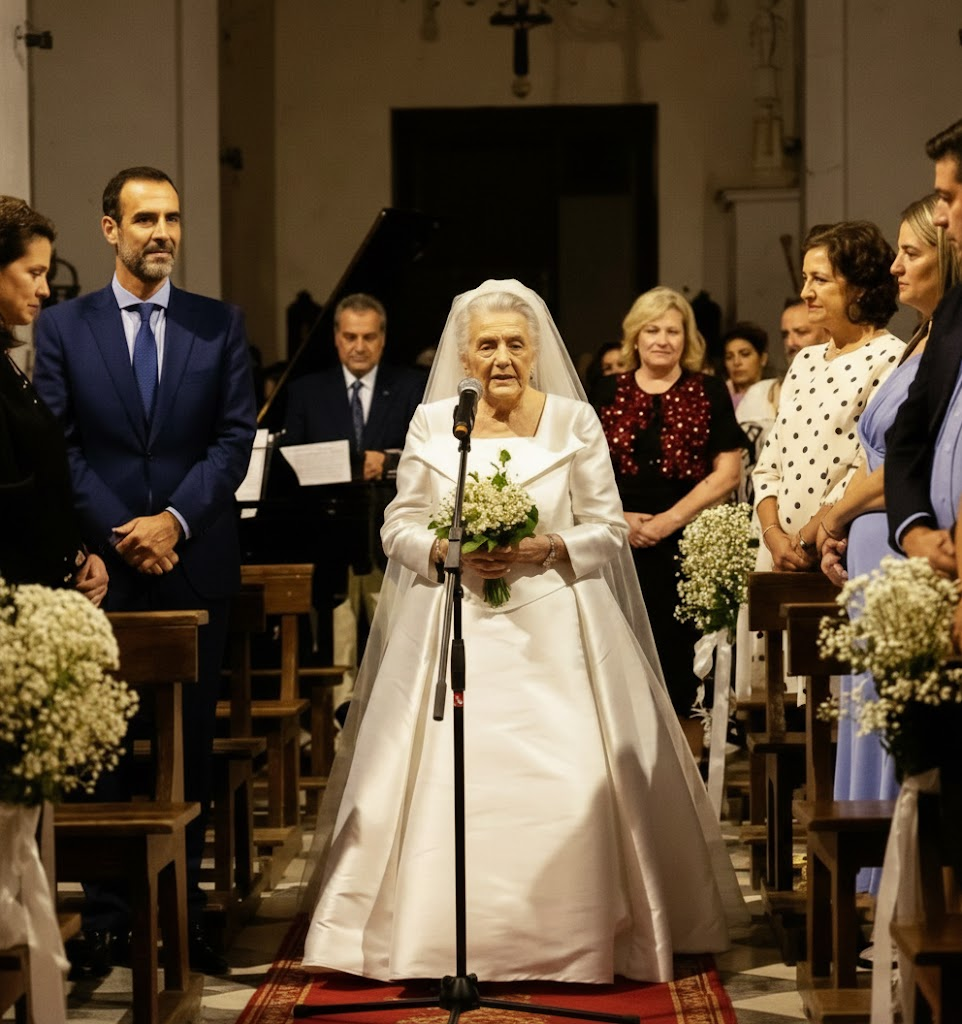
The wedding was set for a Saturday in May, and somehow, everyone came. Children who hadn’t spoken in months. Grandchildren who barely knew her stories. Even a sister who traveled from far away. The church was simple, nearly empty except for family, but it felt full. Carmen entered dressed in white, leaning on her youngest grandson’s arm, her smile trembling with emotion. When he whispered about the groom, she only said, “He’ll arrive.” Minutes passed. Whispers grew. Pity crept in. But Carmen remained calm, steady, as if everything was unfolding exactly as planned.
At last, she asked for the microphone. Her hands shook—not from age, but from courage. She thanked everyone for coming, then spoke the truth that fell heavy into the room. There was no groom. There never had been. She hadn’t planned a wedding—she had planned a reunion. She spoke of how, after her husband died, she slowly disappeared too. Not suddenly, not dramatically, but quietly, as life pulled everyone else forward. She didn’t blame them. She understood. But she refused to fade without one last moment of togetherness.
Tears filled the church as Carmen confessed why she chose a wedding. “People always come for weddings,” she said. She didn’t want to become a name mentioned in passing, a message read quickly. She wanted to live something real with her family while she still could. When she finished, silence hung in the air—until her daughter stood, crossed the aisle, and held her tightly. Apologies followed. Hugs spread. Laughter broke through tears. That day transformed into a true celebration, filled with stories, shared meals, photos, and promises that finally felt sincere.
Carmen passed away peacefully two months later, but she did not leave this world forgotten or alone. Her family returned—to visit, to call, to sit beside her. One grandchild later wrote that she hadn’t faked a wedding out of confusion, but out of clarity. She understood something powerful: love sometimes needs an excuse to come back. Carmen’s final gift wasn’t a ceremony—it was a reminder. Presence matters. Time is fragile. And the people who raised us should never have to invent a reason to be loved again.