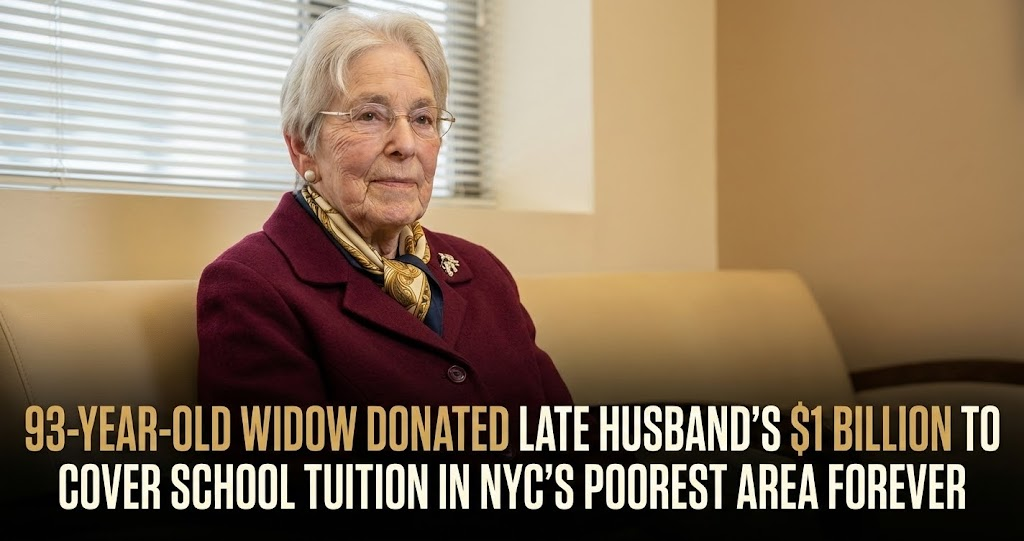
At 93 years old, she sat quietly, her hands folded, her face calm, carrying a decision larger than most lives ever hold. She was a widow now, living with memories instead of noise, with time instead of urgency. The world expected her fortune to pass silently into foundations, buildings, or names carved in stone. But she had been thinking about something else entirely—children who walked past closed doors, empty backpacks, and dreams delayed by money they never had.
Her husband had built a fortune measured in billions, a lifetime of work turned into numbers few could imagine. After his death, the wealth became hers to decide. Advisors came with charts. Lawyers came with plans. Everyone assumed the money would stay within elite circles, universities already rich, causes already funded. But she kept thinking about places where opportunity barely knocked—neighborhoods where talent existed but tuition blocked the door.
New York City’s poorest areas were never far from her thoughts. She knew the schools. She knew the statistics. She knew how early potential disappears when families must choose between rent and education. While others debated policy, she made a personal decision. Education would be the inheritance. Not buildings with her name. Not awards. Not legacy dinners. Just open doors, year after year, for children who had been told “maybe later” too many times.
The donation wasn’t symbolic. It wasn’t temporary. It was structured to last forever. Tuition covered, generation after generation, for students in the city’s most underserved communities. Long after she would be gone, long after headlines faded, the money would keep working quietly—paying fees, buying books, keeping dreams alive. No cameras in classrooms. No speeches at graduations. Just students walking in because someone, once, said yes.
People struggled to understand her choice. Why give it all away? Why not keep some? Why not honor her husband differently? Her answer was simple. He believed in education. He believed in fairness. And she believed that wealth meant nothing if it didn’t change the future for someone else. Money, she felt, was only powerful when it removed barriers—not when it built monuments.
She didn’t ask for gratitude. She didn’t want children to know her name. She wanted them to focus on learning, not surviving. In neighborhoods where college felt like a distant rumor, it would now feel possible. In families where debt crushed ambition, relief would quietly arrive. Her gift wasn’t loud. It was steady. And that was the point.
At 93, she could have chosen comfort, control, and caution. Instead, she chose faith—in children she would never meet, in futures she would never see. Long after her chair sits empty, classrooms will still be full. And somewhere in New York City, a child will open a book, unaware that a widow once decided their education mattered more than a billion dollars ever could.