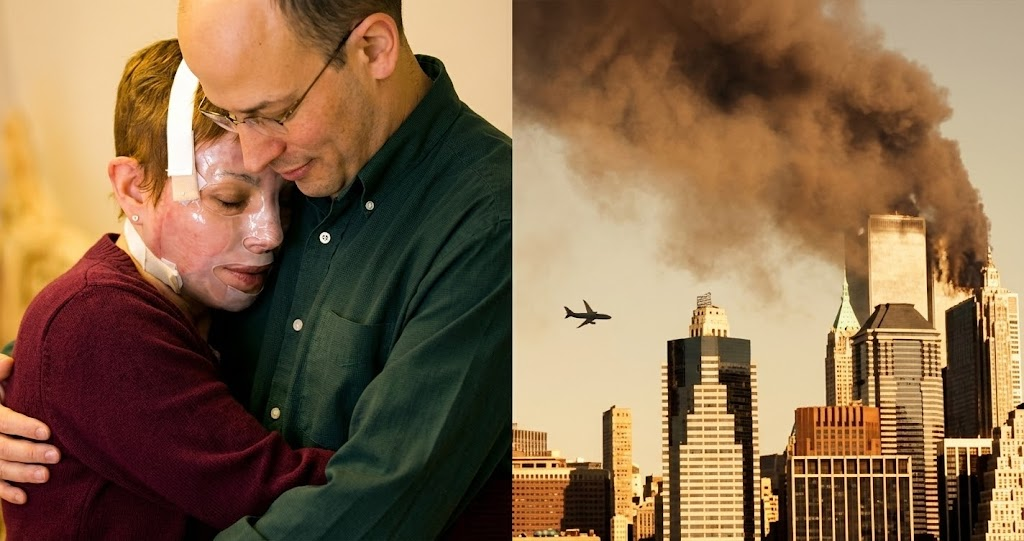
On the morning of September 11, 2001, Lauren Manning was doing what she had done countless times before—walking into work. She was a managing director at Cantor Fitzgerald, entering the lobby of the World Trade Center North Tower, thinking about meetings, deadlines, and the rhythm of an ordinary workday. In a fraction of a second, that normal life disappeared. When the first plane struck, a massive fireball ripped through the lobby, turning glass, steel, and air itself into weapons. Lauren was caught directly in it. Flames engulfed her body. Heat tore through her clothes and skin. In an instant, she was burned over more than 82 percent of her body. Most people never walk out of that kind of inferno. Lauren did—but the cost would follow her for years.
Emergency responders rushed her to the hospital, where doctors faced a reality few families are ever prepared to hear. Her burns were catastrophic. Her body was failing. Her chances of survival were estimated in the single digits. They placed her in a medically induced coma, unsure if her organs could withstand the trauma. For weeks, her loved ones lived between hope and heartbreak, measuring time not in days but in breaths. The world outside mourned the thousands lost in the September 11 attacks, while inside a hospital room, one woman fought a quieter, slower battle—one that would demand more endurance than anyone imagined.
Lauren’s recovery was not a miracle moment. It was a brutal process measured in months and years. She underwent countless surgeries—skin grafts, reconstructive procedures, treatments that pushed her body to its limits. Pain was constant. Progress was slow. After months in intensive care, she began the exhausting work of relearning basic movements through physical and occupational therapy. Even simple tasks—standing, walking, holding objects—became daily challenges. She was finally discharged from the hospital in December 2001, but leaving the hospital did not mean leaving the struggle behind. Rehabilitation continued long after, reshaping not just her body, but her understanding of strength, patience, and survival.
What made Lauren’s story remarkable was not only that she lived—but that she chose to face what came next with honesty. She returned to life visibly changed, carrying scars that told a story before she ever spoke. She navigated a world that often looks away from visible trauma, learning to exist again in public spaces, workplaces, and relationships. Rather than retreating from that reality, she eventually chose to document it. In 2011, she published Unmeasured Strength, a memoir that does not romanticize survival. Instead, it lays bare the physical pain, the emotional toll, and the relentless effort required to rebuild a life after unimaginable loss.
Lauren’s story challenges the way we think about heroism. Survival is not always dramatic. Sometimes it is quiet, repetitive, and exhausting. It is waking up every day and choosing to continue when the body remembers everything it endured. Her journey stands as a reminder that the aftermath of tragedy does not end when headlines fade. For survivors, the real work often begins after the world moves on. Lauren Manning lived through fire, through impossible odds, and through years of recovery—and in doing so, she gave voice to resilience that cannot be measured by scars alone.She didn’t just survive September 11.
She carried it with her—and still chose to live fully.