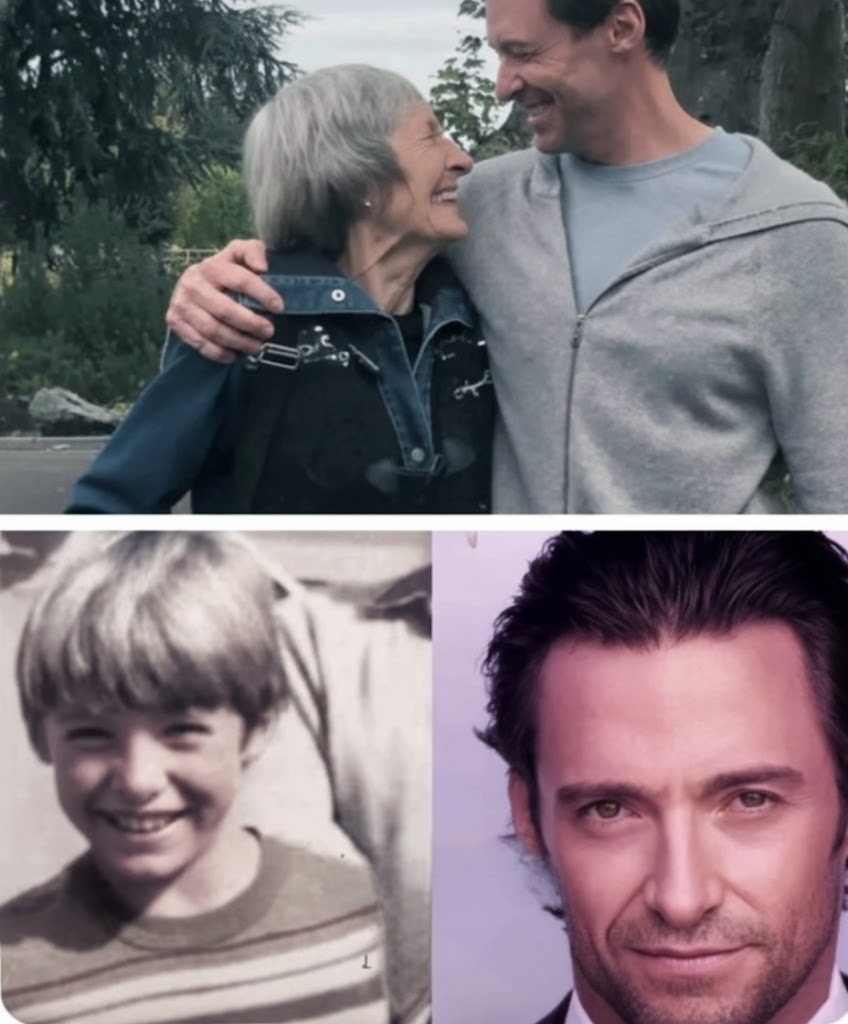
Hugh Jackman remembers the smallest detail from that morning. His mother stood in the kitchen with a tablecloth wrapped around her hair, as if it were just another ordinary day. She smiled, said a soft “bye,” and watched him leave for school. Nothing felt unusual. Nothing warned him that this would be the last normal moment of his childhood.
When he came home that afternoon, the house felt different. Too quiet. Too empty. His mother was gone. No explanation. No note. Just absence. The next day, a telegram arrived from England. It didn’t explain anything either. It simply said that Mom was there. That was all. For an eight-year-old boy, those few words were not information — they were confusion that would echo for years.
Long before the world knew Hugh Jackman as Wolverine, as a global star, or as a symbol of strength, he was just a child trying to understand why his mother didn’t come back. Grace McNeil had left Australia, returned to the United Kingdom, and left behind her husband and five children. No one explained it to him. No one helped him make sense of the silence. He waited, believing she would return. She didn’t.
Life moved forward, but the wound stayed open. Hugh saw his mother only once a year. After the divorce, his sisters moved to England to live with her. He remained in Sydney with his father and brothers. The separation carved invisible lines through the family. By the time he was twelve, the truth finally settled in — not as words, but as pain. He understood then that she wasn’t coming back.
He remembers the weight of it. The quiet shame. The feeling that people were watching, whispering, judging. A mother leaving her children wasn’t something people talked about openly. It wasn’t something that made sense. And for a long time, it hurt in ways he didn’t know how to explain. That kind of pain doesn’t scream — it lingers.
Years passed. Hugh grew older. Stronger. Successful. But childhood wounds don’t disappear just because life improves. They wait patiently. Eventually, he learned something that changed everything: his mother had been suffering from undiagnosed postpartum depression. For the first time, the story shifted. What once felt like abandonment began to look like illness. What felt personal began to feel human.
Understanding didn’t erase the past, but it softened it. Forgiveness followed — not quickly, not easily, but honestly. Hugh has spoken about this with calm clarity: forgiveness is not forgetting. It is not pretending the pain didn’t happen. It is choosing not to stay trapped inside it. Family, he realized, mattered more than anger. More than blame. More than distance.
The boy who once stared at a closed door grew into a man who could face his own story without hatred. The scars never completely disappeared — they rarely do — but they no longer controlled him. Healing came through understanding, through love, and through the courage to say, I don’t hate you anymore.
Some childhood wounds never fully fade. But they can be carried with strength instead of bitterness. And sometimes, that is the truest form of healing.