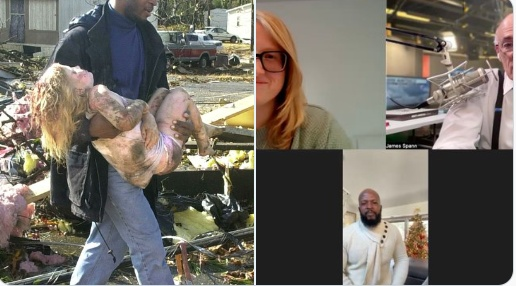
Twenty-five years ago today, an image emerged from the wreckage of an F4 tornado in Tuscaloosa that would never leave the people who saw it. A man walking through debris, his arms wrapped around what appeared to be the lifeless body of a young girl. The scene came from Bear Creek Trailer Park, where homes were torn apart and time seemed to stop. For those who lived through that day, the photograph burned itself into memory—not because it showed destruction, but because it captured the thin line between loss and survival.
The man in the photo was Michael Harris. The little girl was Whitney Crowder, now known as Whitney Daly. In that frozen moment, the world believed it was witnessing death. What it was actually seeing was rescue. Whitney was alive. Against all odds, she survived. But on that day, surrounded by splintered wood and silence, no one could be sure of anything—only that a stranger refused to leave a child behind.
Michael Harris didn’t pause to think about cameras, headlines, or history. He acted on instinct. In the chaos after the tornado ripped through the park, he found Whitney and lifted her into his arms. Every step he took through the wreckage carried urgency, fear, and hope. He didn’t know her name. He didn’t know her family. He only knew she needed help. That choice—made in seconds—would echo for decades, long after the debris was cleared and the news cycle moved on.
The photograph was taken by Michael E. Palmer of The Tuscaloosa News. Distributed worldwide, it became one of the most recognizable images of the disaster. To the public, it symbolized tragedy. To those inside it, it symbolized something else entirely: connection. A moment where two lives, briefly bound by disaster, would forever share a story neither could fully leave behind.
Over the past 25 years, life continued—slowly, imperfectly, bravely. Whitney grew up carrying a past she could not remember, yet one that shaped her in quiet ways. Michael carried the weight of that day, knowing how close the outcome came to being different. They lived separate lives, yet the photograph linked them in ways words could not explain. Survival is not a single moment; it is a long road paved with reminders of what almost was.
Looking back now, the image feels different. What once looked like loss now reads as endurance. What once felt final now feels unfinished—in the best way. It tells a story not just of a tornado, but of humanity rising from chaos. Of a man who ran toward danger. Of a child who refused to be taken by it. And of a moment that reminds us why we still look at old photographs—not to relive the pain, but to honor the lives that continued after the storm passed.