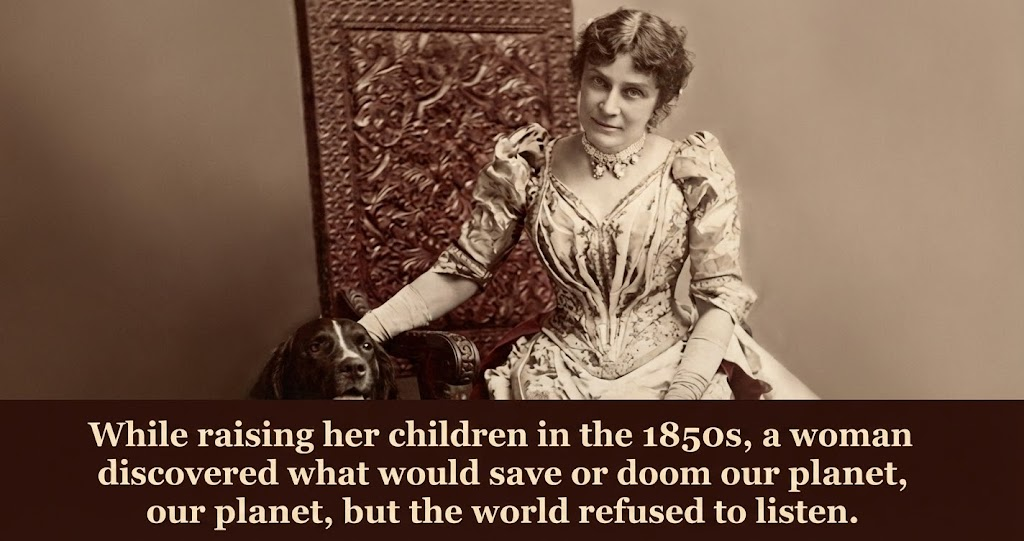
While raising her children in the 1850s, a woman quietly uncovered a truth that could have changed the future of our planet.
But the world refused to listen.
In a small home laboratory, surrounded by glass cylinders, thermometers, and sunlight pouring through the windows, Eunice Foote began asking questions no one else seemed interested in asking. What happens to heat when it passes through air? What changes when the air itself changes?
She didn’t have a university lab.
She didn’t have institutional backing.
She had curiosity—and discipline.
Eunice filled glass cylinders with different gases and placed them under the sun. She carefully measured the temperatures, writing down every result. One gas stood out again and again: “carbonic acid gas,” what we now call carbon dioxide. It heated faster. It stayed hotter longer.
Then she wrote words that echo through history:
“An atmosphere of that gas would give to our earth a high temperature.”
In simple terms, she had just discovered the greenhouse effect.
It was 1856.
When her paper was submitted to the American Association for the Advancement of Science, Eunice was not allowed to present it herself. Women were forbidden from speaking. A male professor read her findings aloud to a room full of men. The paper was published, briefly acknowledged—and then forgotten.
Three years later, a British scientist named John Tyndall performed similar experiments. His work was celebrated. His name entered textbooks. He became known as the father of climate science.
Eunice Foote disappeared.
What makes her story even more powerful is that she understood injustice deeply. Years earlier, she had stood in Seneca Falls and signed the Declaration of Sentiments, demanding women’s right to vote, to speak, and to be heard. She fought for equality in public—while being erased in private.
She predicted climate change long before the world had words for it.
She lived the cost of being silenced.
Today, as rising temperatures reshape our planet, we are finally learning her name. Not just as a scientist, but as a warning.
Because Eunice Foote didn’t only show us what carbon dioxide could do to Earth.
She showed us what happens when the world refuses to listen to brilliant minds—simply because of who they are.
And the question still remains:
How many voices did we ignore?
How many solutions did we lose?
How different would our future look if we had listened sooner?